
“Age is an issue of mind over matter. If you don’t mind, it doesn’t matter.” — Mark Twain.
Decline isn’t written in your DNA. It’s written in your daily choices.
You catch your reflection in a store window and see your mother’s or father’s face looking back. Or the cashier offers you a senior discount without asking, and you think, “Really? I look that old!”
What story does that trigger in your mind?
Most of us have internalised a false and limiting story about aging — one that suggests getting older means becoming less.
These aren’t harmless stereotypes.
Your beliefs about aging shape how you experience growing older.
I’m going to take a look at the five most harmful lies and give you some useful strategies to help you defeat each of them.
Lie #1: Your Best Years Are Behind You (The Myth of Irrelevance)
The Lie: Society teaches us that our most significant contributions, learning, and growth happen before 50. After that, we’re expected to gracefully handle decline and make way for the younger generation.
The Truth: This is backwards. What researchers call “crystallised intelligence” — the wisdom and knowledge you’ve accumulated over decades — actually peaks in later life. Your brain becomes better at seeing patterns, understanding context, and solving complex problems.
You’re not declining. You’re reaching your prime for mentorship, strategic thinking, and subtle decision-making. Studies show that people in their 50s, 60s, and 70s excel at tasks that require experience and judgment.
The real tragedy is how many people internalise this lie and disengage from opportunities where they’d thrive.
How to Break Free:
Action Step: Conduct a “Wisdom Audit.” Grab a notebook and jot down three major challenges you’ve successfully overcome. — career setbacks, relationship crises, financial struggles, and health issues. This isn’t just nostalgia — it’s a timely reminder of your worth and progress.
Mindset Shift: When you catch yourself thinking “I’m too old to start,” immediately reframe it: “My experience has prepared me to succeed at this opportunity.” (Reframe and use a positive phrase that works for you)
Lie #2: Your Body Is Destined to Become Frail (The Myth of Inevitable Decline)
The Lie: Aches, weakness, fatigue, and fragility are unavoidable tickets you must pay for the privilege of aging. If you’re tired or stiff, that’s just what happens.
The Truth: Here’s the reality that changes everything: most of what we call “aging” is actually disuse. Sarcopenia — age-related muscle loss — sounds scary and inevitable, but it’s largely preventable and even reversible with resistance training.
Studies show people in their 70s and 80s can build significant muscle strength. Your bones respond to stress by getting stronger. Your balance improves with practice. Your energy increases with movement.
The decline isn’t written in your DNA. It’s written in your daily choices. When you stop moving, your body adapts to that, not to your age.
How to Break Free:
Action Step: Start a “Strength Snacking” habit. Commit to 10 minutes a day of simple bodyweight exercises such as squats, wall push-ups, or calf raises, standing on one leg while brushing your teeth. These small, consistent efforts maintain muscle, balance, and energy.
Mindset Shift: Stop saying, “I’m having a senior moment” when you feel a twinge or ache. Instead, ask, “What is my body telling me it needs?”

Lie #3: You Can’t Teach an Old Dog New Tricks (The Myth of the Fixed Brain)
The Lie: Your brain becomes rigid with age, making it nearly impossible to learn complex skills, especially in technology. If you didn’t grow up with computers or smartphones, you’ve missed your window.
The Truth: Your brain is neuroplastic — it rewires itself throughout your entire life.
Think of your brain like a forest. Every time you learn something, you create a path. The more you walk that path, the clearer it becomes. Age doesn’t eliminate this ability.
What changes is that you have more existing paths, so new ones require intention. But they form just as effectively.
When you believe you can’t learn, you don’t try. When you don’t try, you don’t learn. The prophecy fulfils itself.
How to Break Free:
Action Step: Choose one “Low-Stakes Learning Project.” Learn a new app, try Duolingo for five minutes daily, watch YouTube tutorials on something you’re curious about. Make it fun, not forced.
Mindset Shift: Replace “I’m not a tech person” with “I haven’t learned that yet.”
That one word — yet — changes everything.

Lie #4: Your Social World Is Supposed to Shrink (The Myth of Inevitable Loneliness)
The Lie: It’s normal and expected for your circle of friends to get smaller as you age. People move away, relationships fade, and isolation is just part of getting older.
The Truth: Some relationships naturally evolve or end, but loneliness isn’t destiny. This is actually your chance to intentionally curate your community.
Build what social scientists call a “social portfolio” — diverse, intergenerational connections based on shared interests and values, not just history or proximity.
Research on longevity consistently shows that strong social connections are as meaningful to your health as not smoking. People with robust social networks live longer, have sharper minds, and report greater happiness.
The difference is that these connections require intention now. You’re not thrown together in offices or school pick-up lines. You need to find them.
The reward is relationships built on genuine compatibility, not convenience.
How to Break Free:
Action Step: Join one group or class based on a genuine interest — book club, cycling club, hiking group, volunteer organisation, art class. Show up consistently. Be a participant, not just an observer.
Mindset Shift: Stop focusing on “losing friends.” Start “looking for like-minded people and groups.”
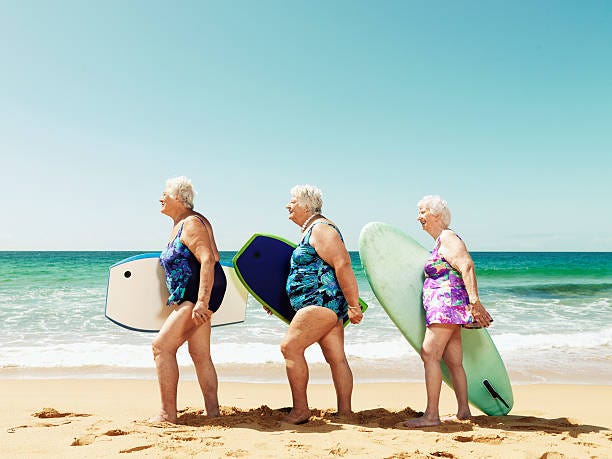
Lie #5: You Need to “Act Your Age” (The Myth of Social Convention)
The Lie: There are unwritten rules about what’s “appropriate” for people over 50 to wear, do, say, or pursue.
- Certain clothes are too young for you.
- Certain activities are undignified.
- Certain dreams should be abandoned.
True ageing success comes from authenticity — this is the gift of aging — the freedom to pursue passions and behaviours that bring fulfilment, regardless of conventional expectations.
The Truth: “Acting your age” is a social construct that unnecessarily confines people. It is a control system based on outdated norms, dating back to a time when retirement meant five years of leisure before death.
So…
- Want to start a business at 65?
- Travel solo at 70?
- Go back to school at 60?
- Change careers at 55?
The true gift of aging is authenticity — the freedom to finally shed others’ expectations and live according to your own values.
The only thing stopping you is this internalised belief that there’s a rulebook you must follow.
There isn’t.
The people living the longest, healthiest lives are often those who ignore these unplanned boundaries.
How to Break Free:
Action Step: Do one small thing this week that your younger self would have loved but you’ve “aged out of.” Buy a bold jacket, blast your favourite music, or take a spontaneous class.
Mindset Shift: Replace the question, “Is this appropriate for my age?” with “Does this make me feel alive?”
Choosing to stay true to yourself instead of following the crowd helps build your confidence, sparks your creativity, and boosts your emotional health.
Age is simply a number, not a barrier.
If you haven’t grown up by 60, you don’t have to!
Your Future Is Unwritten
These five lies — that your best years are gone, your body must fail, your brain can’t grow, your world must shrink, and you must conform — are cultural myths, not biological truths.
The research is clear: you are in the driver’s seat. Aging isn’t something that happens to you. It’s something you do, shaped daily by your beliefs, choices, and actions.
The story of your next 30 years isn’t just an ending to your “real life”. It’s the most thrilling chapter so far — you get to be you.